Pages

Showing posts with label ASD. Show all posts

Tuesday, March 26, 2013

Simple Kindness: Fixing a Broken Cheeseburger


I couldn't help but smile when I saw this story on the evening news. The story has since gone viral. You can easily use Google to find multiple articles/posts about this story, so I'll just link to one such report in this post.

Basically, the simple actions and kindness of one Chili's waitress made all the difference for one family's visit to the restaurant. Arianna MacLean is a 7-year-old girl with autism. She ordered a cheeseburger while her family was dining at Chili's. When her cheeseburger left the kitchen, it had been cut in half- a standard procedure for all childrens' burgers at Chili's. However, when Arianna saw her cheeseburger, she thought that it was "broken" and didn't want to eat it. Arianna's older sister explained the issue to their waitress, Lauren. Instead of arguing or having a negative/dismissive attitude, Lauren agreed that the cheeseburger was "broken", apologized, and promptly delivered a new- uncut- cheeseburger to Arianna.

After staring at the cheeseburger for a few moments, Arianna then bent down and kissed it.

When you have a family member with an autism spectrum disorder, even the simplest family outings can be problematic. Sensory issues and social difficulties can make these outings stressful for everyone involved. Lauren's response in this situation was fantastic and should serve as a model for other employees in the service industry. Individuals with autism are different- not less. It's important that their feelings and thoughts are validated and treated with respect.

Aside from going above and beyond to make Arianna's dining experience an enjoyable one, Lauren has also become Facebook friends with Arianna's older sister, Anna. Providing exemplary customer service and making a new friend? All in a day's work for Lauren!

Saturday, March 23, 2013

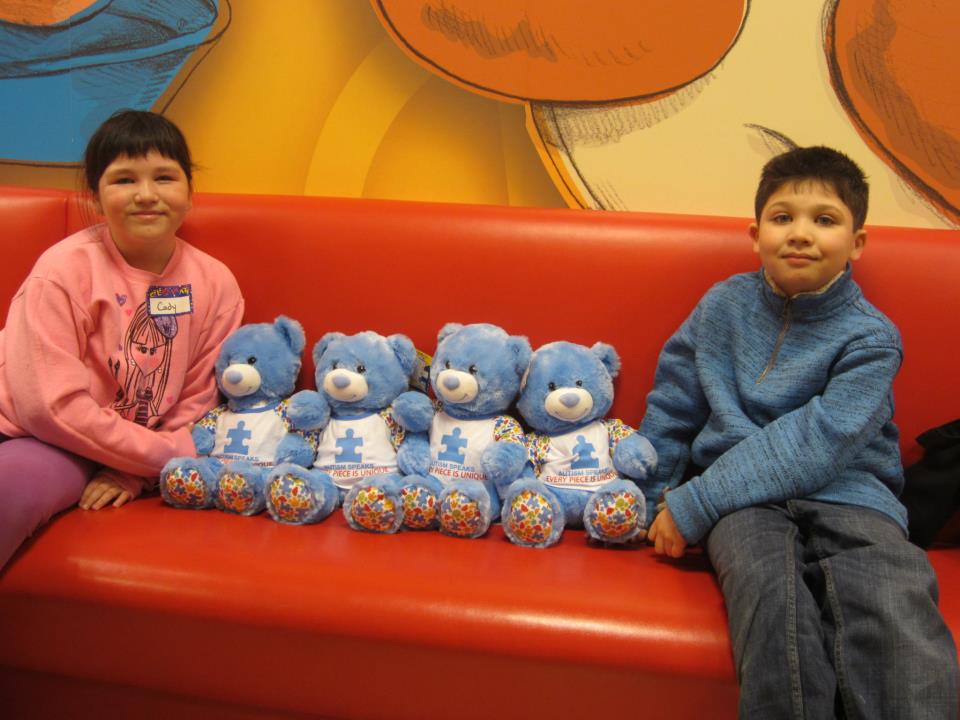
Build-A-Bear Will be Lighting it Up Blue for Autism Awareness!

Image Courtesy of Autism Speaks (Facebook)
Build-A-Bear has teamed up with Autism Speaks to celebrate Autism Awareness with a one-of-a-kind furry friend! The bears will be available in participating Build-A-Bear workshops across the USA on March 27th. From what I've heard, each store will only be receiving a limited shipment of these bears, so once they're gone, they're gone.

I know that many of us have varying opinions of Autism Speaks. I understand that- I also have issues with the way they approach the topic of autism, as well as their approach (or lack thereof) to individuals with autism. However, this... this is just cute. Wifey really wants to get me one. I'm not complaining!

If you would like to get ahold of this special blue bear, give your local Build-A-Bear store a call and/or stop by any participating location on March 27th!

Wednesday, March 6, 2013

Temple Grandin Answers Questions via AutismLive


In this video, Dr. Temple Grandin answers many viewer questions. Topics include advice for parents of children with autism, some words about the Sandy Hook tragedy, and upcoming speaking events, to name a few.

The video is a bit lengthy- 40 minutes long- but well worth watching. The beginning of the video offers an "index" of sorts, listing the times for each specific question. So, if there are certain questions/topics that you're interested in, you can easily skip through the video.

Tuesday, November 27, 2012

"Aware" Businesses Help Families of Children with Autism


If you have any kind of experience with children on the autism spectrum, then you know that sometimes the "simple" things in life can become quite the challenge. Enjoying a meal at a restaurant can present its own unique challenges for an individual diagnosed with an autism spectrum disorder (ASD). For example, a bustling restaurant environment can prove to be very overstimulating and bewildering; an individual with an ASD may also require special assistance when ordering their food.

Fortunately, there are some restaurant owners who recognize the difficulties that these individuals face and are willing to go the extra mile to make things a little more comfortable for them.

The article linked above also features a video report.

I think it's great that some people are willing to step up and work a little harder in order to promote an inclusive environment. Kudos! Maybe this will become the start of a new trend in the restaurant industry?

Thursday, September 13, 2012

A Test That Predicts Autism?

Apparently, scientists in Australia have developed a genetic test to predict autism. Now, because I'm not an overly negative person, let me say this: I can see a positive side to this. If diagnosed early in life, intervention can greatly reduce the impact of behavioral and cognitive deficits on the child's life.

Of course, there's also the giant, glaring elephant in the room: the parents would have the option to abort a baby that is diagnosed with autism.

Naturally, there are people on both sides of the fence. Personally, I'm still ON the fence. My biggest concern is that tests like these will lead to the abortion of many babies with autism, simply because the parents don't want to put the time and effort into their child. Being diagnosed with autism does mean that the road will be more difficult, but it's not a death sentence. In fact, there are many who would view their autism as a blessing, a gift in disguise.

Either way, it's something to think about.

Wednesday, July 18, 2012

Family of Eric Kisly Wants Understanding for Asperger's

You can read the original article here.

This is a sad story on many different levels. There is an assumption that those with Asperger's, or those on the high-functioning end of the spectrum, need less assistance with everyday things. That's simply not true. Take this article, for example. It points out that Eric was the ideal employee: he was focused, honest, and hard-working. So why couldn't he find a job? Because he lacked many of the social skills that others tend to take for granted. Unfortunately, in our society, the interview process isn't based solely on an individual's qualifications. A lot of "small talk" and social cues are involved in the hiring process. Unless someone has a fair understanding of these social aspects of the interview process, their chances of finding employment are slim.

When they do find employment, these individuals still face daily struggles: socializing with co-workers, getting along with their boss, dealing with customers, and adapting their routines to the organizational demands of a corporate environment, to name a few.

Although early intervention can be important, I feel that it's equally important to educate adults about Asperger's and autism spectrum disorders. The co-worker that keeps to himself, never making eye contact? He's not necessarily aloof; he may want to initiate contact but lack the social skills required to do so.

What a sad story. Eric was young, smart, and showed a lot of promise. I really hope that we can create a better world, one in which people can look past their first impressions.

Wednesday, January 11, 2012

Looking Forward at the Autism Spectrum: My Thoughts

As much as I respect John Elder Robison, I would have to disagree with his latest blog post. Don’t get me wrong- I understand his argument, and I hear what he’s saying. However, I feel that trying to “confine” the label of autism would hurt more than help the cause.

Every single individual with autism is different; I have yet to meet two that are exactly alike. Some are verbal, some are nonverbal. Some achieve communication via sign language. Some possess more severe learning disabilities than others. Some are able to be “mainstreamed” into regular schools with little or no additional assistance; others are forever working at their own pace in special schools.

If we try to narrow the definition of autism, how many children will be overlooked and left without assistance? How do we even begin to narrow the definition of autism? Is the label of “autistic” reserved only for nonverbal individuals? Must all autistic individuals exhibit rocking behavior or have a special interest in numbers? If that’s the case, then what happens to the OTHER children- for example, those who exhibit rocking behavior but who are also verbal?

The thing about autism is that it does affect each individual differently. I’m no scientist, but I would think that in order to truly understand a disability you would want to examine the entire spectrum rather than limiting your research to a few attributes. My fear is that, in restricting how we view autism, we are crippling research that could be groundbreaking. It’s true that not every breakthrough may assist every single individual with autism; that’s why we as humans take things one step at a time, or in this case one victory at a time. A breakthrough in communication for individuals with autism may be meaningless for the parents of a verbal child with autism, but it could mean the world to the parents of a nonverbal child with autism.

Having Asperger’s, I do realize that many of my behaviors are different from the behaviors of an individual diagnosed with autism. However, I have also seen my behaviors reflected in many of the autistic individuals that I’ve met. I understand that, as John Elder said in his blog post, many of these individuals are more “crippled” than I am. We should not lose sight of their plight just because some individuals are “less” autistic than others, by medical standards. But can’t we, for example, look at an individual deemed as having Asperger’s or being on the high-functioning end of the spectrum, examine the ways in which they have overcome the more severe aspects of their disability, and utilize it to further research and educational practices for our more “crippled” brothers and sisters? Absolutely!

When it comes to autism, the media is truly a double-edged sword. On the positive side, it’s nice to get a little exposure; at times, we may even feel a connection to a particular TV character, which can be a good thing for our self-esteem. To use an example that many people would be familiar with, look at Sheldon Cooper on “The Big Bang Theory.” They have never come out and said that his character was diagnosed with Asperger’s; however, Sheldon exhibits so many Aspergian characteristics that many viewers feel safe in assuming that he has Asperger’s. For me, personally, seeing a character like Sheldon is non-offensive; from an objective standpoint, he’s a pretty successful figure! He earned a Doctorate, he’s teaching in a subject that’s clearly his “special interest”, he’s able to support himself, and he even has a decent social life. Yes, his character can be socially naïve, but to someone like me that can be almost reassuring. To see Sheldon commit a social faux pas, particularly one that I may have committed in the past, gives me a sense of relief. I can laugh about it, and I’m sure that other people like me are laughing for the same reasons; it’s absolutely wonderful to have these little moments whereupon I realize that I’m not alone. In my opinion, the character of Sheldon Cooper does not represent Asperger’s; rather, he represents an individual, more than likely undiagnosed, living with Asperger’s and doing his best to relate to the world around him.

Unfortunately, as John Elder said, the media can also offer up some nauseating portrayals of autism. Recently, I’ve seen previews for a new TV show called “Touched.” From what I can tell, the plot is something like this:

-Man has autistic son.
-Autistic son is nonverbal.
-Autistic son has a special interest in numbers.
-Autistic son’s special interest turns into bizarre “superpower”, as father reads into the numbers and “translates” the connections in the real world.

I loved Kiefer Sutherland in 24, but I highly doubt that I’ll be tuning in for this new show. The previews themselves make me angry; I mean, here we have yet another show that will give the general public the idea that individuals with autism possess an innate genius, or an innate “superpower.”

How about we make some "New Year's Resolutions" for the autism spectrum? These would be my suggestions:

-Refrain from limiting the criteria necessary for a diagnosis of autism. This is a spectrum disorder, and we should examine any and all symptoms if we are to find the key to unlocking the mystery of the disorder.
-Maintain a focus on "recovered" individuals with autism, but with an emphasis on adapting the "curriculum" or "activities" that enabled them to recover and applying them to a wider audience. What works for one person may not work for everyone... but it may work for enough of them to be worthwhile.
-Take media portrayals of ASDs with a grain of salt.
-Live, laugh, and love. Isn't that what life is all about?

Many thanks to John Elder for writing such a great blog post and inspiring me to think more about these issues.

Friday, February 18, 2011

Asperger's Explained for Children

A few months ago, when I was searching online for some general information on Asperger's, I stumbled on this video. Anyone remember the Arthur books? Well, they turned the books into a pretty fun cartoon series for kids. I was surprised to see the show tackle the issue of autism, and even more surprised that they managed to explain things so well. Yeah, it's a very generic description, but you have to keep in mind that this cartoon is aimed at a much younger audience. So, with that in mind, I'd say that the writers did a great job at explaining Asperger's in a way that young children can understand.

There are four parts to this episode, but you should be able to access them through the first part that I've linked to in this entry. Check it out if you have some time; it's a fun watch.